|
|
| 14-01-2026 |
|
-------------------------------------------
Navigation
-------------------------------------------
https://www.habiter-autrement.org/ > Co-Housing/Coop -------------------------------------- What is Cohousing?
Cohousing is the name of a type of collaborative housing that attempts to overcome the alienation of modern subdivisions in which no-one knows their neighbors, and there is no sense of community. It is characterized by private dwellings with their own kitchen, living-dining room etc, but also extensive common facilities. The common building may include a large dining room, kitchen, lounges, meeting rooms, recreation facilities, library, workshops, childcare.
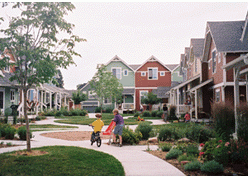
Cohousing communities are usually designed as attached or single-family homes along one or more pedestrian streets or clustered around a courtyard. They range in size from 7 to 67 residences, the majority of them housing 20 to 40 households. The modern theory of cohousing originated in Denmark in the 1960s among groups of families who were dissatisfied with existing housing and communities that they felt did not meet their needs.http://www.cohousing.org/what_is_cohousing A cohousing community is a type of intentional community composed of private homes supplemented by shared facilities. The community is planned, owned and managed by the residents – who also share activities which may include cooking, dining, child care, gardening, and governance of the community. Common facilities may include a kitchen, dining room, laundry, child care facilities, offices, internet access, guest rooms, and recreational features.Cohousing facilitates interaction among neighbors for social, practical benefits, economic and environmental benefit. In describing New York City's first co-housing project, a recent New York Times article said co-housing "speaks to people who want to own an apartment but not feel shut off by it, lost in an impersonal city."http://en.wikipedia.org/wiki/Cohousing What is cohousing - Slide share: This is a powerpoint used by Chris ScottHanson when he gave a public presentation on Cohousing for the Brooklyn Cohousing group (brooklyncohousing.org) on 10/12/07 - 49:50 http://www.slideshare.net/brooklyncohousing/what-is-cohousing-5-12-03 What Is Cohousing by Jwilbern on Jan 04, 2011 - 19 slides http://www.slideshare.net/Jwilbern/what-is-cohousing-6446810Cohousing blog - Cohousing is a type of collaborative housing in which residents actively participate in the design and operation of their own neighborhoods. http://www.cohousingblog.com/Sur la route des utopies http://www.christophe-cousin.com/category/surlaroutedesutopies/
Usually, cohousing communities are designed and managed by the residents, and are intentional neighborhoods: the people are consciously committed to living as a community; the physical design itself encourages that and facilitates social contact. The typical cohousing community has 20 to 30 single family homes along a pedestrian street or clustered around a courtyard. Residents of cohousing communities often have several optional group meals in the common building each week.
This type of housing began in Denmark in the late 1960s, and spread to North America in the late 1980s. There are now more than a hundred cohousing communities completed or in development across the United States.
The Main Characteristics of Cohousing
1. Participatory Process.
2.
Neighborhood Design.
3. Private homes supplemented by common facilities.
4. Resident management.
5. Non-hierarchical structure and
decision-making.
6. The community is not a primary income source for
residents. Source: http://www.cohousing.org/overview.aspx
-------------------------------------------
Navigation ------------------------------------------- ...https://www.habiter-autrement.org/ > Co-Housing/Coop Contact pour HA: lreyam@gmail.com
|