|
|
|
14-01-2026 -------------------------------------------
Navigation
-------------------------------------------
https://www.habiter-autrement.org/ > Autres -------------------------------------- Neighborhood Women Making Democracy Work Mendocino - California
Une communauté de femmes à Mendocino, au nord de San Francisco https://creation-designs.com/gracemillennium/sojourn/fall98/html/maryrose.htm
"In order for democracy to work, people have to find time to take an active, informed part."
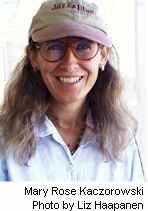
An Interview with Mary Rose Kaczorowski I grew up in a small town in New Jersey during the 1960s housing development boom. Bulldozers ripped apart the woods and hills and quickly, over one summer, a treeless housing development appeared. Many animals also vanished. Surrounding properties ended up with flooded basements. This was my first ecology lesson--seeing the collapse of an eco-system as a result of people making decisions and taking action without considering the ecological impact.
My grandmother on my mom's side came through Ellis Island at the turn of the century, at a time when Europe was facing brutal poverty--poverty that we cannot imagine. My mom, one of eleven children, told me stories of discrimination between various ethnic groups (of white European decent). My father was also an emigrant--a survivor of the holocaust and of both Russian and German work camps. He was finally liberated by the allied army in Holland and came to the United States in 1950. My family legacy deeply affected me as a child and as an adult. I've been to Ellis Island and to the Holocaust Museum in Washington, D.C., and have come to believe that it is fear and complicity that leads to the horror of war and movements like McCarthyism. When people don't ask questions, and allow their fears to be manipulated for political ends, and go along with a scapegoat rationale, a power system can become entrenched. Once that happens, it is too late to ask questions.
UN statistics tell us that women are more than fifty percent of the world's population. Women do two-thirds of the world's work, receive only ten percent of the wages, and own less than one percent of the property. Although women have the least resources and capital, public policies assume they are on a level playing field in the market economy. Not so! We know that women feel devalued by society when they are capital-poor. Many of us work very hard just to make ends meet. Since women share so many issues related to these inequities, coalitions of our various organizations are crucial.
The National Congress of Neighborhood Women (NCNW) is a value-based organization in which low-income urban and rural women are encouraged and empowered to participate and/or lead in community building and peer learning exchanges. Through networks of individuals, women's community-based organizations and their partners (businesses, foundations and other partner groups), NCNW works toward goals of self-empowerment, nurturing of communities, honoring diversity, economic self-determination, preservation of neighborhoods, governmental accountability, coalition building and support of the environment. These goals are supported by values of mutual respect and spiritual openness, combined with the belief in each woman's strength and capacity to define and creatively solve problems. Part of our goal is to help women recognize their skills, and how to apply them in their communities to get what they need in a manner that is not alienating or degrading to themselves or others.
DELEGATES TO HABITAT II As national delegates from Common Ground USA, Judith Vidaver and I attended the United Nations Habitat II Conference on Human Settlements. We were among the 15,000 individuals from 165 countries who attended this historic 1996 conference in Istanbul, Turkey. What was Habitat II about? Why is it important? Habitat II was the culmination of the previous conferences of this decade--the women's conference in Beijing, the Earth Summit Conference in Rio, the Children's Summit in New York City, the Social Conference in Copenhagen, and the Population Conference in Cairo. Since governments of the world are realizing that today's problems are too overwhelming for them to solve alone, "civil society" was invited to participate on a limited basis. This was a first civil society includes non-governmental organizations (NGOs)--the business community, community-based organizations and non-profits. Displaced peoples with no nation status, like the Tibetans, also participated in this forum. Exchanges in the form of daily briefings occurred between the high-level UN conference and the NGO forum, which were taking place concurrently.
Judith and I networked with various other NGO coalitions on rural issues, environmental protection, land economics and gender equality. GROOTS International, the Women's Environmental Developmental Organization (co-founded by the late Bella Abzug), the NCNW, and the UN Huairou Commission were the key organizations who formed "The Super Coalition of Women, Homes and Communities." This coalition worked on ensuring that the language from the Beijing Platform for Action was included in the Habitat Agenda. Issues of gender equality and equity were at stake. In partnership with the Huairou Commission, the Super Coalition accomplished the inclusion of 125 references to women and gender in the Habitat Agenda and succeeded in fighting back the repressive language of reactionary governments.
THE HABITAT AGENDA The Habitat Agenda--the document that came out of the conference--recognizes that the key to a sustainable community is adequate shelter, access to clean water, food, air and land, and an Earth-friendly economy. All sectors of the civil society and governments need to work together in partnership to create solutions to the problems we now face. Every person is an important part of the solution. World governments have agreed to implement the voluntary action-plan strategies of the Habitat Agenda.
BRINGING IT ALL BACK HOME The level of organization, and the partnerships created by the Super Coalition, inspired Judith & me, and we realized what was possible elsewhere. After returning from Istanbul, we appeared on various radio talk shows to "bring back home" the Habitat Agenda and the stories of women we had met. We also made a report back to the community at the Fort Bragg Town Hall.
Discussions with other women in our community helped us realize that no formal networking was taking place among the various women's organizations in Mendocino County, and there was no active grassroots effort to organize women. We were inspired by the work of other NCNW women-including women from The Woodland Community Land Trust in Clairfield, Tennesee. This twenty year old, community-owned land trust is dealing with issues of rural poverty in Appalachia, and has succeeded in creating housing and a sustainably managed forestry model. Our regions share issues of loss of natural resources with problematic environmental and economic consequences.
Mendocino Neighborhood Women is applying its commitment to the Habitat II Agenda and to the land via information exchanges in its support of the Foxglove Farm in Comptche. We have been holding some of our meetings there, and have also hosted farm work parties, potlucks and educational venues. Women come with their children to nurture themselves and the land--enjoying the fresh air and each other's company while learning about raising healthy organic foods in tune with the cycles of nature. Carol Judy from Woodland has been advising Foxglove Farm how to access info. and resources to facilitate the placement of the farm into a protected land trust.
THE PROCESS OF COMMUNITY As one of five local MNW women, I recently attended the Eighth Annual National Congress of Neighborhood Women's Summer Institute on Women and Community Development. Contributors came from around the country--representing groups from public housing tenant associations to rural land trusts. As one of the several priorities set at the 1997 NCNW national strategy meeting in Washington, D.C., the summer institute offered a Leadership Support Processes (LSP) training. Its value-based agreements can be applied to any area of life. The training sourcebook outlining this process is based on over twenty years of experience. You know Robert's Rules of Order? Like so many other rules in society, women had no part in their creation. The Neighborhood Women's agreements offer empowering alternative to Robert's Rules--guidelines such as listening to each other with full attention, making "I" statements, speaking from personal experience (not third- or fourth-party hearsay), and avoiding put-downs. We also separate issues from personalities. Any type of meeting can be very hard to sit through when people spend their time trashing others rather than speaking to the issues. This is a hindrance to building trust, and doesn't develop community at all.
Community is where our family and friends are, where our support systems are, where our values are. We need to empower each other and ourselves to build more healthy communities. All women are potential leaders in this process. MNW wants to promote peer exchanges among rural women--from our local area and from other regions--to share what is working for them. We need more women to participate and be given space when policies are being made that affect their lives and the lives of their children and families.
When people ask me, "What is MNW?" I tell them it is not just about "issues." It is about the "process" of networking and coalition-building. Empowerment comes when we're working together, exchanging information and creating supportive learning situations. That's where the permission, validation, encouragement and the energy come from. From here, I say the possibilities are endless.
Mary Rose Kaczorowski is the co-founder of Mendocino Neighborhood Women and coordinator for the NCNW Land Issues Task Force.
-------------------------------------------
Navigation ------------------------------------------- ...https://www.habiter-autrement.org/ > Autres Contact pour HA: lreyam@gmail.com
|